


History of Homelessness
A homeless person is someone who does not have a regular house or dwelling as they cannot afford it, or are otherwise unable to maintain regular, safe and adequate housing.
Homelessness has always been an issue in Britain throughout the last 1000 years
There has been, until recent years, a large breach between the upper and lower classes. Those in the lower classes were on low wages, if employed at all, and lived in severe poverty and possibly found themselves homeless through losing their job or the death of the main wage earner in the house.
Even as far back as the 7th Century, laws were passed to punish vagrants. They were forbidden to leave the land where they worked and weekly searches were initiated to round any vagrants up.
Poverty was rife in Medieval times and awareness was raised through various uprising such as the Peasants Revolt in 1381, though it took centuries before any major changes happened to attempt to relieve the burdens of the lower classes. The revolt itself was a failure but it marked the beginning of the end of serfdom which is a situation similar to slavery where the individual is bound to the wealthy land owner legally, economically and socially. The ‘serfs’ were required to work for the land owner in return for protection and justice.
Various parliamentary Acts and Bills were passed during the next few hundred years to attempt to control the ‘vagrants’. Between the 1400’s and 1500’s there was next to no distinction between the able-bodied homeless and the sick and infirm. In 1495 a statute was passed so that all vagabonds would be put into the stocks for 3 days and nights and then told to move on when they were released. This did nothing to solve the problem…it just passed the buck! In 1530 the stocks were replaced by whipping…which again did nothing to solve the problem!
By 1531, those who were sick or disabled were given license to beg, but those who were just without work would not be able to. In 1547 vagrants were branded with a ‘V’ and subjected to 2 years servitude for their first offence. If they offended again, they would be put to death. In 1572 persistent beggars were to be bore through the ear or hanged if they continued to offend.
In 1553, Bridewell Palace in London was converted into a mixture of a prison, hospital and workrooms. It was termed ‘a house of correction’ for homeless children and the disorderly poor. Similar institutions were later set up around the country, borrowing the name Bridewell.
In 1597 the Act for the Relief of the Poor was written which provided the first complete code for relief of poverty. This was then amended into The Elizabethan Poor Law in 1601 which was a little more forward thinking and leant towards correction rather than punishment of vagrants. In 1662, the Poor Relief Act encouraged vagrants to stay in the areas where they were born as poor relief would only be given to those who were established residents of the parish.
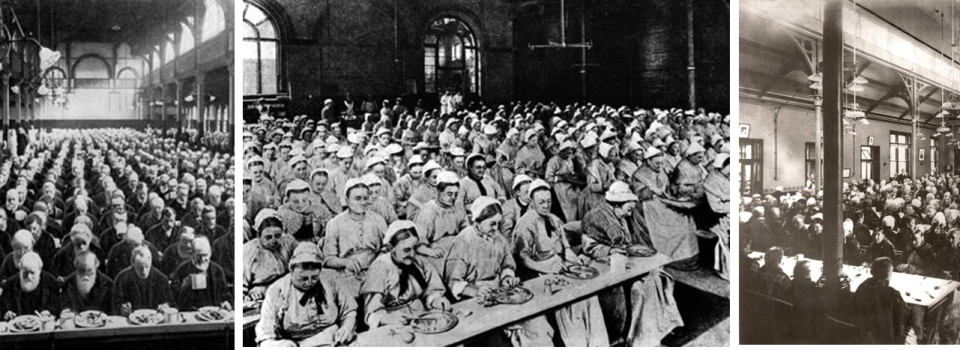
‘Relief’ of the poor continued to develop with the introduction of the workhouse in the early 17th century. The workhouse was intended to be harsh to try and discourage the reliance of state help. Workhouses were used for the next few hundred years, developing during the Victorian era into the segregated building that we hear about today. They were split into the aged and impotent, children, able-bodied males, and able-bodied females. The workhouse system was abolished in the Local Government Act of 1929.
Though the workhouse system was abolished, many of the buildings remained in the control of the local councils and still housed many people without anywhere to live, especially children. In 1948 with the National Assistance Act, the last remains of the Poor Law disappeared, and with it the last of the workhouses.
Through the early 20th century, there were two world wars and the Great Depression which left a lot of poverty and despair in its wake. Homelessness was growing… and concern was growing with it. As the century progressed, so did the attempts in helping those in need. Initiatives such as ‘Coming in from the Cold’ were introduced which increased the number of hostel beds so as to attempt to alleviate the ever growing homeless problem.